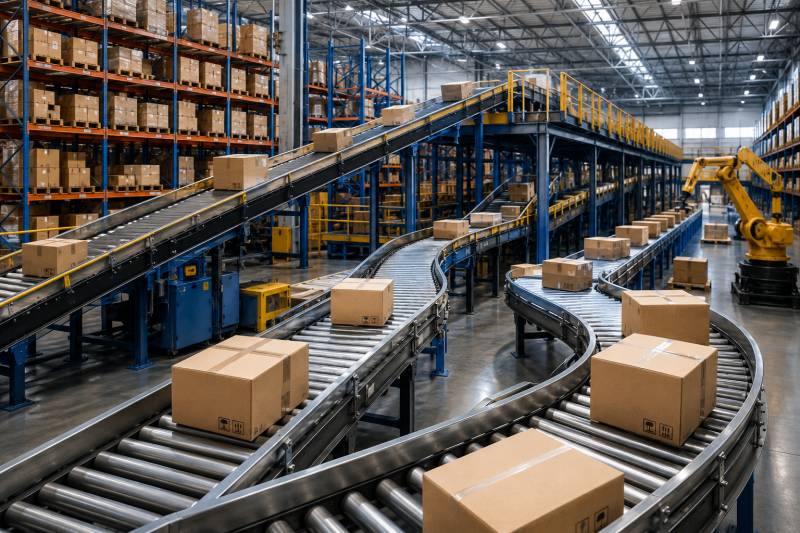
In today's fast-paced logistics and supply chain industry, warehouses are expected to process more orders in less time while maintaining accuracy and reducing operational costs.
Manual material handling often slows down warehouse operations; increases labor expenses, and leads to product damage or delays. This is where modern conveyor systems make a significant difference.
Designed to automate the movement of goods, conveyor systems streamline warehouse operations, improve productivity, and enhance workplace safety. Leading conveyor manufacturers provide customized conveyor solutions that help businesses optimize storage, order picking, packaging, and shipping processes. Whether you operate a small warehouse or a large distribution center, investing in the right conveyor system can transform your operational efficiency.
What Are Modern Conveyor Systems?
Modern conveyor systems are automated material handling solutions that transport products, cartons, pallets, and packages from one location to another with minimal human intervention. Unlike traditional conveyors, today's systems integrate advanced technologies such as sensors, programmable logic controllers (PLCs), barcode scanners, RFID, and IoT monitoring to ensure faster and more accurate operations.
These intelligent systems are widely used in warehouses, distribution centers, manufacturing facilities, e-commerce fulfillment centers, food processing plants, pharmaceutical industries, and logistics hubs.
Why Warehouse Efficiency Matters
Warehouse efficiency directly affects customer satisfaction, operational costs, and business profitability. An efficient warehouse can:
- Process more orders in less time
- Reduce labor costs
- Minimize product damage
- Improve inventory accuracy
- Shorten delivery times
- Increase storage utilization
- Enhance employee safety
Modern conveyor systems help achieve these goals by automating repetitive material handling tasks and ensuring a continuous flow of goods.
Ways Modern Conveyor Systems Increase Warehouse Efficiency
Faster Material Movement
Conveyor systems transport products quickly and continuously throughout the warehouse. Instead of workers manually moving goods between storage, packing, and dispatch areas, conveyors handle the transportation automatically.
- Faster order processing
- Reduced travel time
- Improved workflow
- Increased daily output
Reliable conveyor manufacturers design systems that can handle varying product sizes while maintaining consistent speed and accuracy.
Reduced Manual Labor
Manual handling consumes valuable employee time and increases the risk of fatigue and workplace injuries. Conveyor systems automate repetitive transportation tasks, allowing employees to focus on quality control, inventory management, and customer service.
- Lower labor costs
- Improved employee productivity
- Reduced physical strain
- Better workforce utilization
Improved Order Picking Efficiency
Order picking is one of the most time-consuming warehouse operations. Conveyor systems transport picked products directly to packing stations, reducing unnecessary walking and handling.
- Faster order fulfillment
- Higher picking accuracy
- Reduced processing time
- Improved customer satisfaction
Better Inventory Management
Modern conveyor systems integrate with Warehouse Management Systems (WMS), barcode scanners, and RFID technology to provide real-time inventory tracking.
- Accurate stock monitoring
- Reduced inventory errors
- Better stock visibility
- Simplified inventory audits
Warehouse managers can monitor product movement instantly, making inventory management more efficient.
Increased Warehouse Throughput
Automated conveyors allow warehouses to handle significantly more products per hour compared to manual operations.
Whether processing incoming shipments or dispatching customer orders, conveyor systems maintain a continuous workflow, reducing bottlenecks and improving overall warehouse performance.
Optimized Warehouse Space
Modern conveyor layouts are designed to maximize available floor space. Overhead conveyors, spiral conveyors, and vertical lifts allow businesses to utilize unused vertical space while keeping the warehouse organized.
- Better space utilization
- Organized storage areas
- Improved traffic flow
- Increased storage capacity
Reduced Product Damage
Frequent manual handling can result in damaged products, especially fragile items. Conveyor systems move products smoothly and consistently, minimizing impacts and handling errors.
Industries that benefit include: e-commerce, food processing, pharmaceuticals, electronics, and consumer goods.
Enhanced Workplace Safety
Safety is a major concern in warehouse operations. Conveyor systems reduce heavy lifting, repetitive movements, and forklift traffic, lowering the risk of workplace accidents.
- Fewer employee injuries
- Reduced lifting-related strain
- Improved workplace organization
- Compliance with industrial safety standards
Faster Packing and Shipping
Conveyor systems deliver products directly to packing stations, where automated labeling, weighing, and sorting systems can process them efficiently.
- Faster packaging
- Accurate labeling
- Quick dispatch
- Reduced shipping delays
Support for Warehouse Automation
Modern warehouses increasingly use robotics and automated storage systems. Conveyor systems integrate seamlessly with these technologies to create fully automated workflows.
Examples include:
- Robotic picking systems
- Automated sortation systems
- Packaging machines
- Barcode verification
- AI-driven warehouse management
Experienced conveyor manufacturers develop conveyor solutions compatible with advanced warehouse automation technologies.
Types of Conveyor Systems Used in Warehouses
Belt Conveyors
Suitable for cartons, packages, and lightweight goods over long distances.
Applications: Order fulfillment, Packaging, Distribution
Roller Conveyors
Ideal for transporting boxes, crates, and pallets.
Applications: Warehouses, Logistics centers, Shipping departments
Chain Conveyors
Designed for heavy-duty material handling.
Applications: Industrial warehouses, Manufacturing plants, Heavy equipment movement
Spiral Conveyors
Used where floor space is limited.
Applications: Multi-level warehouses, Distribution centers
Flexible Conveyors
Easy to move and ideal for temporary loading and unloading operations.
Applications: Loading docks, Parcel handling, Courier services
Industries That Benefit from Warehouse Conveyor Systems
Modern conveyor systems improve efficiency across many industries, including:
- E-commerce
- Retail distribution
- Food and beverage
- Pharmaceuticals
- Automotive
- Electronics
- FMCG
- Cold storage
- Logistics
- Third-party logistics (3PL)
Latest Trends in Warehouse Conveyor Technology
Leading conveyor manufacturers continue to innovate with smart technologies that improve operational performance.
- IoT-Enabled Monitoring: Real-time performance monitoring helps detect issues before they become major problems.
- AI-Based Predictive Maintenance: Artificial intelligence predicts maintenance needs, reducing downtime and repair costs.
- Automated Sortation Systems: High-speed sorters improve parcel handling and shipping accuracy.
- Energy-Efficient Motors: Modern conveyor systems consume less electricity while delivering high performance.
- Smart Sensors: Sensors automatically detect product size, weight, and movement for precise material handling.
Conclusion
Warehouse efficiency is a key factor in boosting productivity, lowering operating costs, and ensuring timely, accurate order fulfillment. Modern conveyor systems simplify material handling by automating the movement of goods, reducing manual work, maximizing available warehouse space, and improving overall workflow efficiency.
Working with trusted conveyor manufacturers enables businesses to implement customized conveyor solutions tailored to their operational requirements. These advanced systems support warehouse automation, increase productivity, enhance workplace safety, and prepare businesses to meet the growing demands of today's fast-paced supply chain industry. Investing in a high-quality conveyor system is more than improving product movement—it's a strategic step toward creating a smarter, safer, and more efficient warehouse.

